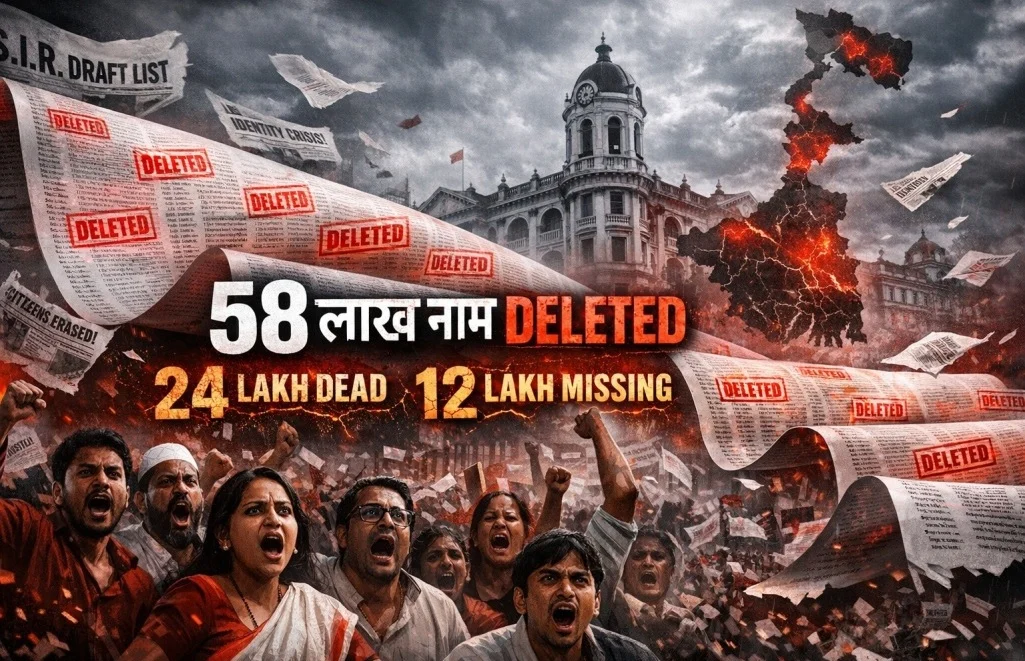
58 Lakh Names Deleted in Bengal Draft SIR: 24 Lakh Marked Dead, 12 Lakh Missing
The Election Commission of India (ECI) published (Bengal Draft SIR) West Bengal’s draft electoral rolls on December 15, 2025, after the Special Intensive Revision (SIR), revealing over 58 lakh names proposed for deletion ahead of the 2026 Assembly elections. This massive cleanup targets deceased voters, duplicates, relocated individuals, and those untraceable at registered addresses, marking the first such comprehensive exercise since 2002. The move has ignited political debates in the poll-bound state.
Bengal Draft SIR: Breakdown of Deletions
Breakdown shows 24.18 lakh voters marked as dead, 19.93 lakh as relocated (with entries in multiple lists), 12.01 lakh as missing after multiple Booth Level Officer (BLO) visits, and 1.38 lakh as duplicates or bogus. An additional 57,604 names fall under other categories, while 58.17 lakh SIR forms remained uncollected, leading to provisional exclusions. These figures stem from door-to-door verifications where 99.99% forms were distributed and 99.86% digitized.
Process and Timeline of Bengal Draft SIR
SIR involved BLOs mapping 76% of voters against 2003 rolls, with 91% forms distributed and 80% returned. Affected voters can file claims via Form 6 for corrections; final rolls are due in February 2026, post-objections, before poll announcements. Lists are accessible online via ECINET app or ECI website for checks.
Bengal Draft SIR: Political Implications
Deletions vary sharply across constituencies, prompting scrutiny over uneven impact and potential disenfranchisement. With uneven distribution—higher in some areas—this could reshape the electorate, fueling opposition claims of irregularities amid TMC’s dominance. ECI emphasizes the exercise ensures clean rolls, but tensions are rising.
What caused the large number of deletions during SIR
The large number of deletions in West Bengal’s Special Intensive Revision (SIR) stems from a rigorous door-to-door verification process identifying deceased voters, those untraceable at registered addresses, relocated individuals, and duplicates. Over 58 lakh SIR enumeration forms went uncollected, triggering provisional exclusions after Booth Level Officers (BLOs) conducted multiple visits.
Key Deletion Categories
Deletions break down as follows: 24.18 lakh voters marked dead, 12.01 lakh missing after BLO checks, 19.93 lakh relocated with entries in multiple constituencies, and 1.38 lakh duplicates or bogus entries. An additional 57,604 names fall under other reasons, linked to the first comprehensive SIR since 2002 mapping against older rolls.
Verification Process
BLOs distributed 99.99% of forms and digitized 99.86%, but tight timelines from December 4-11 led to challenges like heavy workloads and protests. This exposed longstanding issues such as outdated records from migration-heavy districts and unupdated deaths. ECI views it as essential cleanup for accurate rolls ahead of 2026 polls.
Which districts had the highest deletion rates in the SIR exercise
South 24 Parganas recorded the highest deletions at 818,431 names, followed closely by North 24 Parganas with 792,133. Other districts with major impacts include Howrah (447,340), Kolkata North (390,390), and Hooghly (318,874).
Top Districts Table
| District | Deletions |
|---|---|
| South 24 Parganas | 818,431 hindustantimes |
| North 24 Parganas | 792,133 hindustantimes |
| Howrah | 447,340 hindustantimes |
| Kolkata North | 390,390 hindustantimes |
| Hooghly | 318,874 hindustantimes |
These urban and peri-urban districts, TMC strongholds, saw elevated deletions due to migration, uncollected forms, and outdated records during SIR verifications. Bankura’s Kotulpur had the lowest at 5,678.
For latest updates Click Here!


