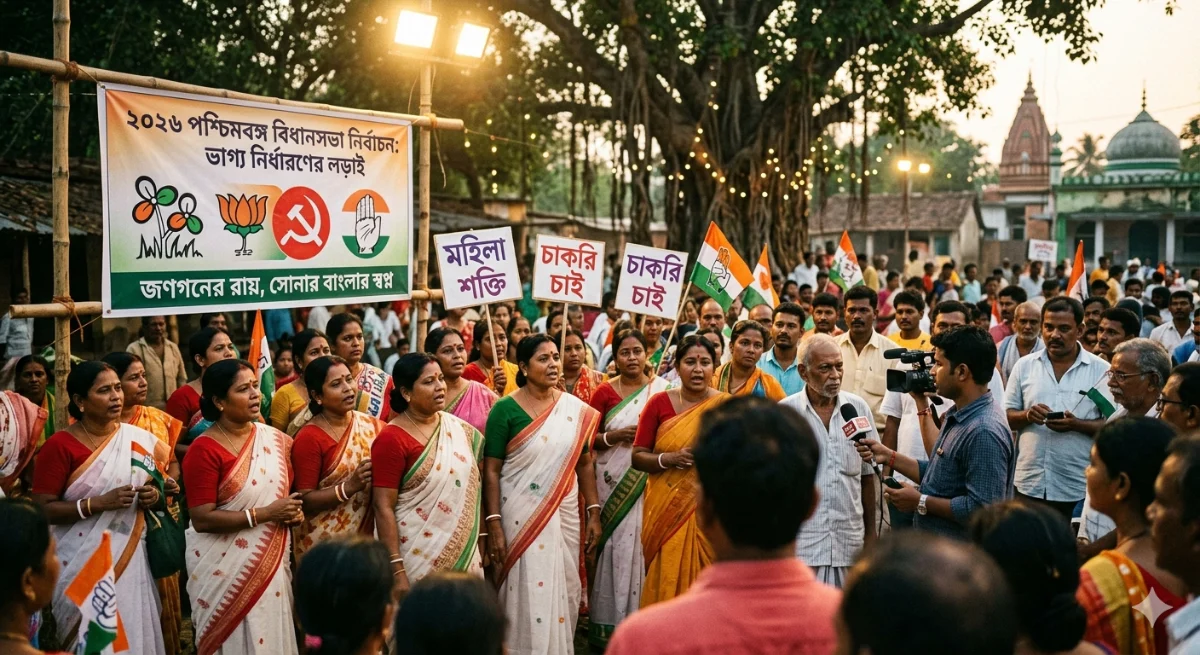
West Bengal Assembly Election 2026: Complete Analysis, Data & Political Outlook
The 2026 West Bengal Assembly Election is one of the most crucial state elections in India, with a direct contest primarily between the ruling All India Trinamool Congress (TMC) and the opposition Bharatiya Janata Party (BJP). The election will determine whether Chief Minister Mamata Banerjee secures another term or if the opposition led by Suvendu Adhikari can shift power.
Election Schedule & Basic Facts (2026)
- Total seats: 294 Assembly constituencies
- Majority mark: 148 seats
- Polling dates: 23 April & 29 April 2026
- Counting date: 4 May 2026
- Registered voters: ~6.75 crore
- Male voters: ~3.60 crore
- Female voters: ~3.44 crore
- Third gender: ~1,300+ voters
The election is being held in two phases, unlike the eight phases in 2021, indicating improved logistics and security planning.
Major Political Parties in 2026
Primary Contest
Other Parties
- Indian National Congress (Contest all 294 seats solo)
- Communist Party of India (Marxist) (Left Front)
- Indian Secular Front (ISF)
- All India Majlis-e-Ittehadul Muslimeen (AIMIM)
Congress has decided to contest all 294 seats independently, making the election more fragmented.
2021 Election Results (Baseline for 2026 Analysis)
| Party | Seats (2021) | Vote Share |
|---|---|---|
| TMC | 215 | 48.02% |
| BJP | 77 | 38.15% |
| Left + Congress | 0 | ~10% combined |
| Others | 2 | — |
TMC won a landslide victory, but BJP emerged as main opposition for the first time in decades.
Key Takeaway
- TMC dominance in South Bengal
- BJP strong in North Bengal & border districts
- Left-Congress collapse
Voter Demographics & Electoral Mathematics
West Bengal voting patterns are influenced by:
1. Minority Vote Bank
- Muslim population: ~27%
- Concentrated in Malda, Murshidabad, North Dinajpur
- Traditionally favors TMC
- BJP needs breakthroughs here to win majority
2. Rural vs Urban Divide
- Rural voters: welfare-driven
- Urban voters: employment & governance
3. Women Voters (Key Deciding Factor)
Women beneficiaries of schemes like:
- Lakshmir Bhandar
- Kanyashree
- Swasthya Sathi
This group heavily influenced the 2021 TMC victory.
2026 Opinion Poll Trends
Recent projections show tight contest but TMC slightly ahead.
- TMC leading in vote share
- BJP strong in close contests
- Large undecided voters
- Congress/Left limited impact
Another survey suggests anti-incumbency at MLA level but leadership still strong, benefiting TMC.
Campaign Narratives (2026)
TMC Strategy
- Welfare schemes
- Bengali identity politics
- Women voters focus
- Anti-central narrative
BJP Strategy
- Law & order
- Corruption allegations
- Citizenship & border issues
- Development model
The BJP manifesto promises:
- Cash support for women
- Anti-corruption crackdown
- Uniform Civil Code
- Job creation push
Key Battleground Regions
1. North Bengal
- BJP stronghold
- Close contests expected
2. Junglemahal
- Swing region
- Tribal vote decisive
3. South Bengal Urban Belt
- TMC advantage
4. Siliguri Corridor (Strategic)
Both BJP and TMC are focusing heavily here, making it a crucial zone.
Election Commission Measures (2026)
- 100% webcasting of booths
- AI-based monitoring
- Extra security deployment
- Repoll in violence cases
These steps aim to reduce violence and rigging allegations.
Major Issues in West Bengal Election 2026
1. Unemployment
Youth vote decisive
2. Welfare vs Development Debate
TMC: welfare
BJP: infrastructure
3. Corruption Allegations
Teacher recruitment scams
Coal scam
Cattle smuggling issue
4. Law & Order & Political Violence
A major narrative in campaigns
Analytical Seat Projection (Data-Based)
Based on trends, past data, and opinion polls:
| Party | Projected Range |
|---|---|
| TMC | 140–180 |
| BJP | 100–140 |
| Congress + Left | 5–20 |
| Others | 0–5 |
This indicates hung assembly possibility if BJP crosses 130.
What Will Decide the 2026 Election?
- Women voters turnout
- Minority vote consolidation
- North Bengal swing
- Anti-incumbency vs welfare loyalty
- Congress vote split impact
- Youth unemployment narrative
Bengal Draft SIR: Political Implications
The proposed Bengal Draft SIR (Special Intensive Revision) of the electoral rolls has emerged as a significant political factor ahead of the 2026 West Bengal Assembly Election. The revision focuses on verifying voter eligibility, removing duplicate entries, and updating migration-based changes. While the Election Commission positions this as a routine administrative exercise to improve voter accuracy, political parties view it through a strategic lens.
For the ruling camp, concerns revolve around the possible exclusion of welfare beneficiaries and migrant populations, particularly in border districts and urban slums where documentation gaps are common. Any large-scale deletion of names could affect turnout in constituencies where margins are traditionally narrow.
On the other hand, opposition parties argue that cleaner electoral rolls may reduce alleged bogus voting, especially in minority-heavy and border constituencies. They believe this could level the playing field in closely contested seats.
Key Leaders in 2026
TMC:
- Mamata Banerjee
- Abhishek Banerjee
BJP:
- Suvendu Adhikari
- Narendra Modi
- Amit Shah
Congress:
- Adhir Ranjan Chowdhury
Final Analysis: Who Has the Edge?
TMC Advantage
- Welfare schemes
- Women voters
- Minority consolidation
- Strong leadership
BJP Advantage
- Anti-incumbency
- Strong cadre growth
- Urban vote
- North Bengal dominance
Wildcard
- Congress vote split
- Low turnout
- Tactical voting
Conclusion
The West Bengal Assembly Election 2026 is shaping into a high-stakes, closely contested political battle. While TMC enters with structural advantages and welfare-driven support, BJP has significantly strengthened its grassroots presence and remains a formidable challenger. The final outcome will depend on women voters, minority consolidation, and North Bengal swing seats. A narrow victory, coalition scenario, or even a hung assembly remains possible — making this election one of the most unpredictable in West Bengal’s political history.


